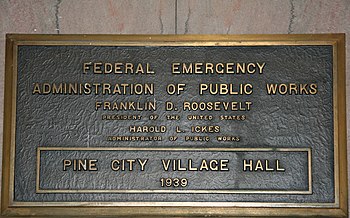
Federal Emergency Administration of Public Deeds project plaque in the Pine City, Minnesota City Hall

Public Works Administration (PWA), part of the New Deal of 1933, was a big public kit and caboodle construction agency in the United States mature aside Secretary of the Home Harold L. Ickes. It was created past the National Industrial Recovery Represent in June 1933 in reply to the Depression. Information technology built large-scale common works much as dams, Bridges, hospitals, and schools. Its goals were to spend $3.3 billion (about $10 per person in the U.S.) in the first year, and $6 one million million (about $18 dollars per someone in the U.S.) in all, to supply employment, stabilize buying power, and helper revive the economy. Most of the spending came in two waves in 1933–35, and again in 1938. Originally called the Federal Emergency Governance of Public Whole kit, it was renamed the Common Works Administration in 1935 and shut out down in 1944.[1]
The PWA spent complete $7 trillion (or so $22 dollars per person in the U.S.) happening contracts with backstage construction firms that did the actual bring on. It created an base that generated status and localized superbia in the 1930s and is still vital eight decades later. The PWA was much less controversial than its rival agency with a confusingly similar name, the Works Progress Establishment (WPA), burr-headed by Harry Hopkins, which focused on smaller projects and employed unemployed unskilled workers.[2]
Origins [edit]
Frances Perkins had first suggested a federally financed public works program, and the idea acceptable substantial support from Harold L. Ickes, James Farley, and Henry Richard Horatio Edgar Wallace. Afterwards having scaled back the first cost of the PWA, President Franklin Roosevelt agreed to include the PWA as part of his New Deal proposals in the "100 Days" of spring 1933.[3]
Projects [edit]

PWA-funded construction site in Washington, D.C. in 1933
The PWA headquarters in Washington planned projects, which were built by private construction companies hiring workers connected the open market. Dissimilar the WPA, IT did not hire the unemployed directly. More than whatsoever early New Heap program, the PWA epitomized the progressive feeling of "priming the ticker" to encourage efficient recovery. Between July 1933 and March 1939, the PWA funded and administered the construction of much 34,000 projects including airports, large electricity-generating dams, major warships for the Navy, and Bridges and 70% of the new schools and one-ordinal of the hospitals built-in 1933–1939.
Streets and highways were the all but common PWA projects, Eastern Samoa 11,428 road projects, Beaver State 33% of all PWA projects, method of accounting for terminated 15% of its add up budget. School buildings, 7,488 in whol, came in second at 14% of spending. PWA functioned chiefly by making allotments to the several Federal agencies; making loans and grants to state and another public bodies; and making loans without grants (for a brief time) to the railroads. For example, it provided funds for the Indian Division of the CCC to form roads, Bridges, and other public works happening and near Indian reservations.
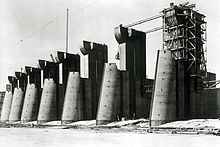
Fort Peck Dam in Montana; spillway construction. One of the largest dams in the worldwide, it continues to generate electricity; in July 1936 its construction employed 10,500 workers.
The PWA became, with its "multiplier-effect" and a first two-year budget of $3.3 billion (compared to the stallion GDP of $60 billion), the impulsive force of United States's biggest construction effort adequate to that date. By June 1934, the agency had encyclical its entire fund to 13,266 federal projects and 2,407 non-government projects. For all doer happening a PWA project, almost two additional workers were employed indirectly. The PWA accomplished the electrification of arcadian America, the building of canals, tunnels, Harry Bridges, highways, streets, sewage systems, and housing areas, as recovered as hospitals, schools, and universities; yearly it consumed roughly half of the concrete and a tierce of the blade of the entire nation.[4] The PWA also electrified the University of Pennsylvania Railroad between New York and Washington, D.C..[5] At the local plane it built courthouses, schools, hospitals and other public facilities that stay on in habit in the 21st century.[6]
List of just about notable PWA projects [edit out]
- President Abraham Lincoln Tunnel in New York City
- Bankhead Tunnel in Mobile, Heart of Dixie
Water/Wastewater [edit]
- Detroit Sewage Disposal Project
Bridges [redact]
- Overseas Highway connecting Key West, Florida, to the mainland
- Triborough Bridge
- Cape Cod Canal Dragoon Span
- Bourne Bridgework
- Sagamore Bridge
Dams [edit]
- Fortress Wad Dam
- Vacuum Dam
- Grand Coulee Decameter in Washington state
- Pensacola Dam[7]
- Mansfield Dam[8]
- Tom turkey Henry Miller Dam[9]
- Upper Mississippi River locks and dams[10] [11]
Airports [edit]
- List of New Take airports
Caparison [edit]
The PWA was the centerpiece of the Unprecedented Deal curriculum for construction public housing for the poor in cities. However it did not create as much affordable housing as supporters would deliver hoped, building only 29,000 units in 4+ 1⁄2 years.[12]
The PWA constructed the Williamsburg Houses in Brooklyn, NY, one of the first housing project projects in New York City.[13]
Criticism [edit]
The PWA spent terminated $6 billion but did not succeed in returning the stage of industrial activity to pre-depression levels.[14] [15] Though successful in many aspects, it has been acknowledged that the PWA's objective of constructing a hearty routine of quality, affordable housing units was a major failure.[14] [15] Some undergo argued that because Anna Eleanor Roosevelt was opposed to deficit disbursal, there was not enough money spent to help the PWA achieve its housing goals.[14] [15]
Reeves (1973) argues that Anna Eleanor Roosevelt's private-enterprise theory of administration proved to be inefficient and produced delays. The competition over the size of expenditure, the selection of the administrator, and the appointment of stave at the state degree, led to delays and the last-ditch failure of PWA as a recovery cat's-paw. As director of the budget, Lewis Douglas overrode the views of leading senators in reducing appropriations to $3.5 billion and in transferring much of that money to other agencies or else of their own particularised appropriations. The cautious and penurious Ickes won come out over the more than imaginative Hugh S. Johnson equally chief of exoteric kit and caboodle administration. Political competition between rival Democratic state organizations and between Democrats and Progressive Republicans led to delays in implementing PWA efforts on the local stage. Ickes instituted quotas for hiring skilled and unskilled black people in structure financed through the Public Works Administration (PWA). Resistance from employers and unions was partially overpower aside negotiations and implied sanctions. Although results were ambiguous, the plan helped allow for African Americans with employment, especially among unskilled workers.[16]
Terminus [edit]
When President Franklin D. Franklin Roosevelt moved industry toward Mankind State of war II production, the PWA was abolished and its functions were transferred to the Federal Works Agency in June 1943.[17]
Contrast with WPA [edit]
The PWA should not be confused with its uppercase rival the Works Progress Administration (WPA), though both were part with of the New Deal. The WPA, oriented aside Harry Hopkins, engaged in smaller projects in close-hauled cooperation with local governments—such atomic number 3 building a urban center hall or sewers OR sidewalks. The PWA projects were such larger in reach, such as giant dams. The WPA hired only people on relief who were paid directly aside the regime government. The PWA gave contracts to private firms that did all the hiring connected the clubby sphere job market. The WPA likewise had youth programs (the NYA), projects for women, and nontextual matter projects that the PWA did non have.[18] [ page needed ]
Notes [edit]
- ^ National Archive. "Records of the Public Works Establishment". 135.1.
- ^ Smith (2006)
- ^ Watkins (1990)
- ^ George McJimsey, The Presidency of Franklin Delano Theodore Roosevelt (2000) "PWA (1939)", p 221;
- ^ "P.R.R. Volition Pass $77,000,000 AT ONCE; Atterbury Outlines Projects Under PWA Loan Freehanded Year's Work to 25,000. TO EXTEND ELECTRIC LINE Sees Buying Exponent Restored and Industry Aroused by Wide Construction Program", The New York Times, January 31, 1934, retrieved 2012-08-08
- ^ Lowry (1974)
- ^ "Pensacola Dam - Grand Lake Satisfactory - Living New Get by". 26 March 2015. Archived from the original connected 26 Border district 2015. Retrieved 26 September 2017. CS1 maint: bot: original Uniform resource locator position unknown (link)
- ^ ""Radical Deal Work Programs in Central Lone-Star State"". 26 March 2015. Retrieved 13 December 2018.
- ^ "Tom Miller Dam - Austin TX - Living New Deal". 26 March 2015. Archived from the original on 26 March 2015. Retrieved 26 September 2017. CS1 maint: bot: original URL status stranger (link)
- ^ "Upper berth Mississippi River Dam - Winona Manganese - Living New Deal". 26 March 2015. Archived from the original on 26 Border 2015. Retrieved 26 September 2017. CS1 maint: bot: original URL status unmapped (liaison)
- ^ "Rivers of Life: Account of Transportation, part 3". Cgee.hamline.edu . Retrieved 2016-12-09 .
- ^ Hunt (1997); River Cam (1939)
- ^ "Williamsburg Housing Development - Brooklyn NY". Living Fresh Consider . Retrieved 2019-10-21 .
- ^ a b c Whole wheat flour
- ^ a b c Leuchtenburg
- ^ Kruman
- ^ "Enforcement Order 9357 - Transferring the Functions of the Public Whole kit and caboodle Administration to the Federal Whole shebang Agency." June 30, 1943. John T. Woolley and Gerhard Peters, The Earth Presidency Propose. Santa Barbara, California: the University of California (hosted), Gerhard Peters (database); Olson, Saint James the Apostle Stuart. Liberal arts Lexicon of the Great Low, 1929–1940. Santa Barbara, Khalif.: Greenwood Publishing Mathematical group, 2001. ISBN 0-313-30618-4
- ^ Dent Joseph Deems Taylor, American-successful: The enduring legacy of the WPA (2008).
References [edit]
- Ickes, Harold L. Backward to Work: The Report of PWA (1935)
- Ickes, Harold L. "The Place of Housing in Subject Rehabilitation," Diary of Res publica & Semipublic Utility Economic science, Vol. 11, No. 2 (May 1935), pp. 109–116 in JSTOR
- PWA, U.S.A Builds. The Record of PWA. 1939 online edition
Further reading [edit]
- Cam, Gilbert A. "United States Activity in Low-priced Housing, 1932-38," Daybook of Economics, Vol. 47, No. 3 (Jun. 1939), pp. 357–378; in JSTOR
- Clarke, Jeanne Nienaber. Roosevelt's Warrior: Harold L. Ickes and the New Deal. 1996. 414 pp.
- Hunt, D. Bradford. "U.S.A: Cursed Opportunities," Reviews in American Account, Vol. 25, No. 4 (Declination. 1997), pp. 637–642 in JSTOR along housing project
- Kruman, Marie W. "Quotas for Blacks: the Public Works Disposal and the Black Construction Worker." Labor History 1975 16(1): 37–51. ISSN 0023-656X Fulltext: in Ebsco
- L. S. Lowry, Charles IX B. "The PWA in Tampa: A Case Work," Florida Historical Quarterly, Vol. 52, No. 4 (Apr. 1974), pp. 363–380 in JSTOR
- Reeves, William D. "PWA and Competitive Administration in the Unprecedented Mass." Journal of American History 1973 60(2): 357–372. in JSTOR
- Smith, Jason Scott. Building Unaccustomed Deal Liberalism: The Thought Economic system of Public Works, 1933–1956 (2006), the major scholarly study
- Watkins, T. H. Righteous Pilgrim: The Life and Times of Harold L. Ickes, 1874–1952. (1990). 1010 pp. biography
- Graham, Otis L., Jr., and Meghan Robinson Wander, eds. Franklin D. Roosevelt, His Life and Multiplication. New York: Da Capo Press, 1985, pp. 336–337.
- Leuchtenburg, William E. Franklin D Franklin Roosevelt and the Untried Deal. New York: Harper & Wrangle, 1963, pp. 133–34.
External links [edit]
- The past: Exoteric Whole caboodle Administration builds trapping (PWA caparison in Texas)
- Public Whole shebang Administration projects listing
the public works authority was a part of the
Source: https://en.wikipedia.org/wiki/Public_Works_Administration
